Friday, August 7, 2015

How To Getting Around Hong Kong

Getting Around Hong Kong

The best way to get around Hong Kong is the Mass Transit Railway (MTR). Ideally, you'll use a combination of the MTR and walking to get places quickly and cheaply. If you dare to take a bus or minibus, you run the risk of missing your intended destination as these two options are hard for visitors who do not speak Cantonese; you need to be able to accurately communicate with the driver. The ferries and the trams offer scenic routes, which you should take when you have time to absorb Hong Kong's bustling environment.
Most visitors arrive through Hong Kong International Airport (HKG), located just off Lantau Island. While many visitors simply hop in a taxi and zoom off to downtown, you can avoid the additional cost of cab fare by using the MTR's high-speed Airport Express. This train takes only 24 minutes to reach the city, and a complimentary shuttle bus will pick up passengers at the Hong Kong and Kowloon stations and transport them to popular hotels nearby. 
MTR 
The Mass Transit Railway (MTR) encompasses a subway system and an above-ground light-rail network that course through downtown Hong Kong and its surrounding territories. The MTR is clean, efficient, cost-effective, and extensive. What more could you ask for? The base fare for a one-way ticket is $4 HKD (about $0.52 USD) and quickly increases depending on the distance traveled. While you can purchase a one-way ticket for each journey, you're better off getting the rechargeable Octopus card or a tourist day pass. These two alternatives will save you money. The Octopus card costs $50 HKD (about $19 USD), which includes a $100 HKD (about $13 USD) initial value. You can be refunded the initial $50 UKD (about $6 USD) if you return the card before you leave. The base fare for a ride with an Octopus card is $3.80 HKD (about $0.49 USD). The tourist day pass costs $55 HKD (about $7 USD) per day and permits unlimited travel on all modes of public transportation. Trains start running at 6 a.m. and terminate between midnight and 1 a.m. depending on the line.
Taxi Three types of taxis, indicated by different colors, serve the Hong Kong territory. You'll find the red in the urban regions, and they will go anywhere except for Tung Chung Road and Lantau Island's south side. Green taxis operate in rural New Territories, so you probably won't run into many of these. Lastly, blue taxis run only on Lantau Island. Each type of taxi maintains a different fare breakdown that will be posted on the taxi's window. Note that passengers are required by law to wear seatbelts when available and you can ask for a receipt at the end of each ride. If you run into traffic or need to cross a body of water, the rate can skyrocket in a hurry, and the ride can take longer than if you used the MTR. In downtown Hong Kong and the Kowloon Peninsula, taxis are easy to flag down from the street. In other areas, you should call the taxi dispatch to request one. 
Bus 
You'll see tons of buses (including double-deckers) on the roads, but unless you know precisely which one to flag down (they will not automatically stop), you're better off taking the less complicated MTR. Three separate companies (listed below) operate the bus lines within the Hong Kong territory. All of the companies accept the MTR Octopus card or exact change onboard. Fares vary depending on the route, so you can sometimes spend less than $2 HKD (about $0.25 USD) and other times more than $20 HKD (about $2.50 USD). You can catch most buses between 6 a.m. and midnight. Some buses, marked "N," operate nighttime routes.
Ferry
While you're in Hong Kong, you really should take a ferry ride. The Star Ferry is the most popular ferry company with tourists; however, there are numerous other companies that operate lines between the Kowloon Peninsula, Hong Kong Island, Macau, mainland China, and the outlying islands. The standard Star Ferry trip across Victoria Harbour costs between $2 and $3 HKD (less than $0.40 USD), depending on the day, the departure and arrival piers, and the deck on which you choose to ride. Consult the Hong Kong Tourism Board's website for more information about the various ferries.
Tram
It may not be the fastest means of getting around, but Hong Kong Island's trams takes you through scenic neighborhoods. Like San Francisco's cable cars, these double-decker streetcars offer an enjoyable sightseeing experience; just don't rely on them for traveling long distances. There is a flat fare of $2.30 HKD (about $0.30 USD), and you must either have exact change or use your MTR Octopus card. Also, remember to board at the rear of the tram.
On FootWhile you should definitely get lost in Hong Kong's streets and stumble upon street markets, you should not rely solely on your feet to get around. The hilly terrain will wear out your legs quickly, and the water divisions make walking impossible. If you do plan to explore on foot, be sure to grab an up-to-date street map from a Hong Kong Tourism Board visitor center.
Minibus
There are two types of minibuses. Green minibuses cost a fixed amount (which will be posted on the bus) and run along pre-determined routes. Red minibuses can stray from their usual route and will drop passengers off along the way. Fare on red minibuses is not fixed, so you'll have to determine the price with the driver. Travelers familiar with Hong Kong's layout and know a fair bit of Cantonese are best served on minibuses. If you do not meet either of those two criteria, consider another transportation option.

Tips & Trick Before go to Hong Kong

Hong Kong

Keep in Mind...

  • Not just a cityHong Kong is, in fact, a territory made of numerous islands and a peninsula. You'll spend most of your time on Hong Kong Island, the Kowloon Peninsula, andLantau Island.
  • Get out of townWhile most people only picture Hong Kong as an urban destination, there are gorgeous seaside parks for you to explore. And with Hong Kong's sophisticated public transit system, you can get out of the city in no time.
  • HKTB is your new BFFHKTB stands for the Hong Kong Tourism Board, an invaluable resource for before and after you've arrived. Stop by the HKTB centers in the airport or in the Tsim Sha Tsui Star Ferry concourse for free information and helpful tips.

How To Save Money in Hong Kong

  • Take the tramPublic transportation is already dirt cheap, but if you are counting your pennies, take the tram when on Hong Kong Island. It only costs $2 HKD (less than $0.30 USD).
  • Book your room earlyWhile Hong Kong's attractions and transportation are very affordable, the hotel room rates can be exorbitant. Book early and don't be afraid to stay a little farther from downtown, as long as you're near an MRT station.
  • Head to the food courtSit-down meals can cost you a pretty penny in tourist areas, but you can usually find inexpensive options in nearby food courts. 


Hong Kong Culture & Customs

Since its reunification in 1997, Hong Kong maintains a complex relationship with mother China. The former British colony continues to operate under a capitalist economy (despite China's communist ways), to have its own currency (the Hong Kong Dollar), and to create new laws. And due to Hong Kong's multicultural population and heritage, the official languages here are Cantonese and English, not Mandarin. American travelers who have visited other Chinese cities like Beijing will notice a much stronger Western influence in the urban landscape, array of food choices, social practices (like greeting with a handshake), and more English speakers. These familiar aspects and the ease of getting around greatly reduce the culture shock that usually visitors experience upon entering China.
You should note that, while it is slightly stronger than the Chinese Renminbi (CNY), the Hong Kong Dollar (HKD) is still weaker than the United States Dollar (USD). One HKD is equivalent to about $0.12 USD.

Best Times to Visit Hong Kong

he best time to visit Hong Kong is between October and December. This period boasts comfortable temperatures and reasonable room rates. After New Years, tourism picks up significantly, despite the falling temps, and leads to higher hotel prices and more crowds. Another sweet spot for affordable travel is the short spring. And while summer remains a popular tourist time, the weather can be stiflingly hot and humid. To protect your wallet, avoid Chinese national holidays and large conventions, when hotel prices soar. Check out the Hong Kong Tourism Board's city calendar for updated information.

October-December
*Best Time to VIsit
Hong Kong will have just recovered from a long, hot summer and maybe even a typhoon. But don't worry: The city's pace never slows down. And from October to December, you'll enjoy daytime temps in the 70s with below-average room rates. However, steer clear of the first week of October, when millions of mainland Chinese tourists flood the city during this national holiday.
Key Events:
January-March
While cool temperatures will discourage some travelers, others (particularly Chinese tourists) will flock to Hong Kong for the holidays. Note that hotels will bump up the rates around the two New Year's celebrations. Temps usually stay in the 60s and low 70s during the day.
Key Events:
April-May
For travelers wishing to avoid both winter's climate and summer's humidity, spring is an exceptional time to visit. But note that your pictures from Victoria Peak may not come out perfectly as fog and rain can sweep over the harbor. At this time, room rates are manageable, unless you hit the tourist wave that accompanies the national holidays. The first week in May is one of these no-go periods.
Key Events:
June-September
In the summer, Hong Kong is hot, muggy, and typhoon-prone. The summer weather doesn't dissuade travelers and depress hotel rates like it once did. So if you are looking for a bargain (or some dry weather), look elsewhere.
Key Events:


Thursday, August 6, 2015

10 Best Things To Do in Hong Kong

Star Ferry

The Star Ferry is an absolute must when you come to Hong Kong. Think of it as the most scenic (albeit slow) way to get between the Kowloon Peninsula and Hong Kong Island. Onboard, you'll discover amazing photo ops of the skyline, particularly at night. OneTripAdvisor user remarks, "The ferries are cheap, quick, clean, and stable (so it should be fine for even those who tend to get sea sick)." So, you really have no excuse to avoid it.
Every day, the Star Ferry Company shuttles passengers from its Tsim Sha Tsui pier (near the promenade) on the Kowloon Peninsula to either its Central pier or its Wan Chai pier on the Hong Kong Island side. The short voyage costs between $2 HKD and $3 HKD (about $0.25 USD and $0.40 USD) for adults. The company also operates an hour-long tour of Victoria Harbour. You can hop on this circuitous route at any of the three piers. A variety of ticket types are available, but standard single-ride, round-trip tickets cost $70 HKD (about $9 USD) during the day and $140 HKD (about $18 USD) at night. For more information, consult the Star Ferry Company's website.

Victoria Peak

Victoria Peak, or simply "The Peak," is one of the most popular tourist attractions and definitely worth battling the crowds to enjoy. "The peak allows you to see and grasp the size of the city," says one TripAdvisor user. But getting to the peak via the tram is an attraction in itself. To reach the Peak Tower at the mountain's apex, you'll take the scenic red tram, which has been operating since 1888. Don't worry: Perfectly safe, modernized cars now run up and down the steep incline. 
You can reach the base of the Peak Tram by walking from the MTR's Central station. Every day, the tram opens at 7 a.m. and closes at midnight. Cars depart every 10 to 15 minutes. Round-trip tickets cost $40 HKD (about $5.15 USD) for adults and $18 HKD (about $2.30 USD) for children and seniors. For more information, consult the Peak's website.

Street Markets

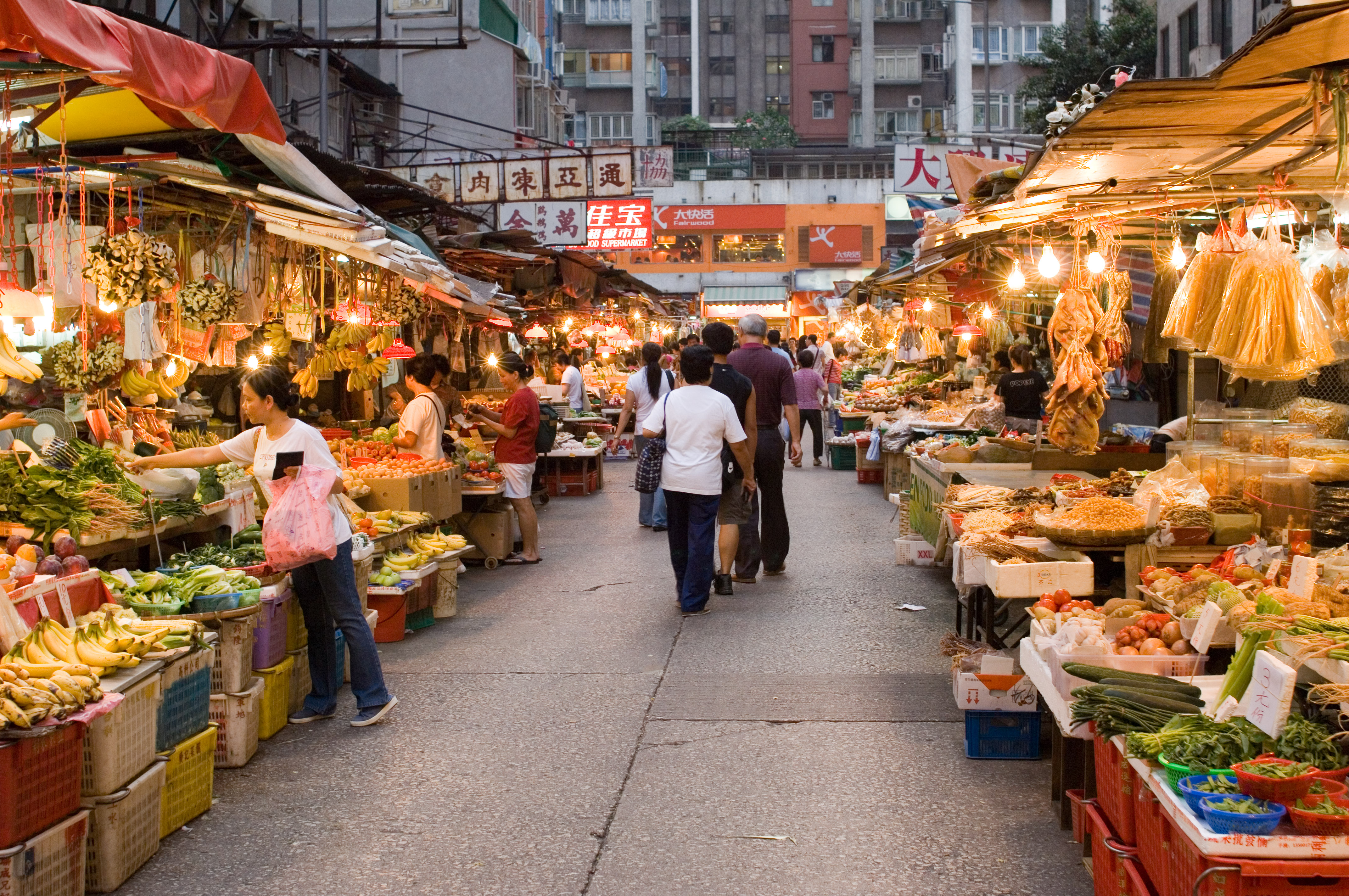
Chances are you'll accidentally stumble upon one of these shopping frenzies on a tour of the city. But don't just stop at one. Hong Kong's street markets are diverse, catering to various clienteles with different merchandise. For instance, the Ladies' Market on Tung Choi Street in the Mong Kok neighborhood specializes in (you guessed it) women's clothing and accessories. Plus, each bazaar also has its own ambience. The best example is the Temple Street Night Market—a traveler favorite. This nocturnal marketplace in the Jordan neighborhood bursts with activity as vendors hawk clothes, electronics, and local culinary snacks from brightly lit stalls. Another bazaar of note is the Stanley Market. Occupying an old fishing village on the southern coast of Hong Kong Island, this marketplace boasts artwork, silk garments, and colorful souvenirs.
Each market operates on different hours. Reaching most of them is usually quite easy as they tend to be close to subway stops.

Happy Valley Racecourse

Nearly every Wednesday, thousands of Hong Kong residents flood the stands of the Happy Valley Racecourse. It's the city's only legal place for gambling, and many take full advantage. You should visit this local institution even if you're not the betting sort. The atmosphere is electric, quite literally—the city skyline sparkles once the sun goes down. One TripAdvisor user says, "The giant track in the middle of the city is amazing, and the whole experience is pretty delightful and surreal." Plus, you can snap some great pictures of the horses.
Standing-in room admission costs just $10 HKD (about $1.30 USD), and tickets for the seated area start at $20 HKD (about $2.60 USD). You can purchase tickets the day of at the track or up to 10 days in advance from several outlets throughout the city. Only visitors 18 years or older are permitted inside the track. Located on Hong Kong Island, you can walk to the track from the MTR's Causeway Bay Station or simply take a taxi from either one of the Star Ferry piers on Hong Kong Island. The races usually last from 7 to 11 p.m.

Tsim Sha Tsui Promenade

On the edge of the Kowloon Peninsula's popular Tsim Sha Tsui neighborhood, the promenade is the quintessential Hong Kong locale for many visitors. On a casual waterfront stroll, you'll have an uninterrupted view of Hong Kong Island. During the day, you can watch the boats stream in and out of Victoria Harbour as you admire the handprints of famous Hong Kongese film stars along the Avenue of the Stars (the equivalent of the Hollywood Walk of Fame). But at night, there is even more to see: From 8 to about 8:20 p.m., the Symphony of the Stars (a sound-and-light show) projects dazzling lights onto the Hong Kong skyline. Day or night, consider taking in the atmosphere at one of the many restaurants and bars located here.
Many travelers remark that the promenade is undeniably touristy, but they still recommend visiting. One TripAdvisor user says, "It looks just like in the pictures (in a good way)."
Beginning near the Star Ferry Pier, the Tsim Sha Tsui Promenade is easily reached via MTR's East Tsim Sha Tsui Station on the West Rail Line. The shops, bars, restaurants, and museums that stand along the promenade maintain varied hours of operation.

Ocean Park

Competing with Hong Kong Disneyland for family travelers, Ocean Park pulls out all the stops. Spectacular natural scenery right on the coastline? Check. A diverse zoo that includes pandas and dolphins? Check. An aquarium with sharks and rays? Check. Electrifying rollercoasters and carnival games? Check. Next thing you know, Ocean Park is going to have a cable-car ride and an underground funicular… Oh wait, it already does!
Recent visitors can't get over how many attractions are packed into Ocean Park. One TripAdvisor user attests, "Ocean Park has [a] lot of things to do and surely, by the end of the day, it will be difficult for you to move your legs (due to tiredness)."
Located on the southern coast of Hong Kong Island, the park is easily reached by taking the Ocean Park Citybus 629 from the Central Ferry Pier no. 7 or Admiralty Station. Consider buying your park tickets at the MTR's Admiralty Station for a slight discount and in some cases, included round-trip bus fare. At the park, general admission costs $280 HKD (about $36 USD) for adults and $140 HKD (about $18 USD) for kids. Visitors are welcome between 10 a.m. and 7:30 p.m. every day.

Nan Lian Garden

When you're exhausted by Hong Kong's fast pace, retreat to the Nan Lian Garden. This nearly nine-acre green space was built in the style of the Tang Dynasty, which ruled from 618 to 907 AD. Walking along the paths, you'll find several gurgling brooks, tree groves, and quiet ponds.
While the Nan Lian Garden is beautiful in its own right, most visitors come to see the Chi Lin Nunnery. Set within the park, this stunning complex is an active nunnery. You may even hear the nuns chanting Buddhist hymns. Although the wooden architecture leads you to believe that the buildings are quite old, construction of the nunnery was, in fact, completed in 1998. Admiring the structure is only half the fun. You can also stop in for a cup of tea and meal. As one TripAdvisor user exclaims, "There is also a vegetarian restaurant serving varieties of Chinese food... It is a must try!"
Nan Lian Garden is open to the public every day from 7 a.m. to 9 p.m., and the nunnery welcomes guests from 9 a.m. to 5 p.m. Admission is free. If you arrive by MTR, take the C2 exit at the Diamond Hill MTR Station and you'll pop up right near the park. 

Hong Kong Museum of History

From dinosaurs to Disneyland, the Hong Kong Museum of History showcases the geography, cultures, and artwork of this urban metropolis. Over 185,000 square feet in size, this large complex boasts exhibits—like "Prehistoric Hong Kong" and "Folk Culture in Hong Kong"—that attract all types of visitors, including families, history buffs, and art connoisseurs. One recent TripAdvisor user remarks, "I thoroughly enjoyed the presentation of artifacts [...] I also like the sense of continuity of the museum, giving you a feel that you are travelling through time."
You'll find the Hong Kong Museum of History in the Tsim Sha Tsui neighborhood on the Kowloon Peninsula. Consider pairing a visit here with the Star Ferry Pier or the Tsim Sha Tsui Promenade. The complex is a short walk from the Hung Hom and Tsim Sha Tsui MRT stations. The exhibition galleries are open Wednesday through Monday from 10 a.m. to 6 p.m. and until 7 p.m. on Sundays and public holidays. Admission costs $10 HKD (about $1.28 USD).

Lantau Island

Like Singapore's Sentosa Island, Lantau Island is a tourist's playground. You've got historical sites, amusement parks, sunny beaches, and more. Families love Hong Kong Disneyland and the Noah's Ark theme park. Active travelers enjoy paddling along Cheung Sha beach and clamming in the Shui Hau mudlands. Even history buffs have their pick of the Big Buddha (it's massive!) and the Po Lin Monastery. Regardless of your interests, you must take a ride on the Nong Ping Cable Cars. Recent travelers rave about the bird's eye view from these gondolas. One TripAdvisor user says, "If you have no fear of heights, take the 'crystal cabins'—cable cars with a see-through glass floor."
You can reach Lantau by taking the Star Ferry, which departs from the Kowloon Peninsula's Tsim Sha Tsui district. If you don't have time for this scenic route, take the MTR's Tung Chung Line from downtown Hong Kong. Once you're on the island, use the New Lantao Bus to get around. A one-day ticket for unlimited bus rides, plus one-way on the cable car, costs $104 HKD (about $13.50 USD) Monday through Saturday and $116 HKD ($15 USD) Sunday and on public holidays. For more information about transportation, consult the New Lantao Bus's website, the MTR's website, or our guide to Getting Around Hong Kong. The different attractions on Lantau maintain different hours and charge varied admission prices. Be sure to check their individual websites before visiting. 

Hong Kong Disneyland

"It's a small world after all" has never been more true than at Hong Kong Disneyland. If you've been to either Disneyland or Walt Disney World, you might be disappointed by the relatively petite size of this park. The Hong Kong iteration has many of the same attractions as the American parks—like Space Mountain and Sleeping Beauty's Castle—only they've been scaled down. One TripAdvisor user says, "I was originally expecting to stay in Disney for most of the day, but ended up finishing the park in about 3 [hours]." Generally, visitors have more positive remarks for Ocean Park, but that doesn't mean travelers didn't enjoy their time spent in "the happiest place on earth."
Positioned on Lantau Island, Hong Kong Disneyland is easily accessible via the MTR's Disneyland Resort Line. The park welcomes visitors from 10 a.m. to 8 p.m. every day. Admission costs $399 HKD (about $51 USD) for adults and $285 HKD (about $37 USD) for kids.


How to Getting Around Bali


Bali Island


Getting Around Bali

The best way to get around Bali is with a hired car and driver. This option gives you the freedom of roaming around the country without the hassle of having to drive yourself. Biking is another option, just be prepared to weave through chaotic traffic. Boats are great way to get to neighboring islands, but they are not frequently used to get around Bali.
Most travelers arrive through Ngurah Rai International Airport (DPS), which is located between Kuta and Jimbaran. To reach your hotel, check in advance to see if there is a complimentary resort shuttle available. If not, grab a taxi at the airport exit.
Bike
For short distances, bikes are the cheap and fun way to go. You'll get to see what's outside of your resort but have the means of easily getting back. Bikes can also be a faster option in traffic-congested towns. You can rent bikes through many of the resorts and small shops in tourist towns, like Kuta.
Hired Car and Driver
This mode of transportation may seem like an extravagant route, but you'll find that this option can be cost-effective and worth every penny. You can usually arrange a car and driver through your hotel; however, there are numerous agencies, like Bali Island Car Rental, that offer the service. Expect to negotiate a price (unless it has been prearranged) and to pay for the driver's food, drink, and accommodations if you've hired him for a multi-day trip. A day's hire should cost about 450,000 IDR (about $50 USD). For the price, you'll have a worry-free means of getting around and potentially a local tour guide. For more information, consult your hotel's concierge.
·         Bali Island Car Rental
Rental Car
Renting a car is easy and affordable, but driving around Bali is difficult with its traffic, its drivers, and its unclear signage. Balinese drivers are reckless by most standards; for example, using headlights at night is considered a courtesy rather than a requirement, and a red traffic light is seen more often as a recommendation than a command. By law, you are required to have an international driving license or a locally issued one. To obtain an international driving license, you must go through the IDL Service online. You can purchase the local option at the Foreign License Service in Denpasar for 150,000 IDR (about $16 USD). While the proper license is good to have, many agencies on the island are fine handing you the keys as long as you have an official driver's license and passport from your country of origin. Rental agencies are located in many resort towns and at Ngurah Rai International Airport.
·         IDL Service
Taxi
Travelers have had a mixed bag of fortunes with taxis. Drivers can be unreliable and even downright crooks. Luckily, most are fair and friendly to tourists. Some taxis run on negotiated prices, while others go according to a meter. Flag drop is usually 5000 IDR (about $0.50 USD), and each additional kilometer is 4,000 IDR (about $0.45 USD). You can hail cabs from the street in larger towns like Denpasar, or you can call for one. Blue Bird taxis are the most reliable, according to recent travelers.
·         Blue Bird Taxi
Bus
Public and private tour buses are an affordable way to explore the island. That said, they don't allow the freedom to explore off the beaten path and can take a very long time to reach their destinations. Bali's most popular private bus tours are organized by Perama Tour & Travel. Bali's public buses go between major towns but routes, costs, and departure and arrival times can be hard to track down.
·         Perama Tour & Travel
Boat
Travelers occasionally use boats and ferries to reach Bali's neighboring islands. This option is not only scenic, but also affordable. For instance, a one-way ride from Bali's Pandangbai to Lombok's Lembar costs about 28,000 IDR (about $3 USD). While public ferries can be cheaper, commercial boat services—like those operated by Perama Tour & Travel, Blue Water Express, and Gillcat—offer speedy and direct transport to the surrounding islands.
·         Perama Tour & Travel
·         Blue Water Express
·         Gilicat

Entry & Exit Requirements


Indonesia requires that your U.S. passport be valid for at least six months from when you enter the country. You must obtain a 30-day visitor visa upon arrival at the airport in Bali. This temporary visa applies to tourist and short-business trips only. If you are coming to Bali for more than 30 days, you must apply for a special visa prior to arrival.

Tips & Trick Before go to Bali


Bali Island - Indonesia

Keep in Mind...

  • Check out remote neighborsThe Gili Islands are about a 90-minute boat ride from Bali's east coast and offer pristine sands and ideal isolation.
  • Know culinary favoritesIn southern Bali, seafood is king. In central Bali, the local specialty is babi guling, which translates to "suckling pig." Be sure to sample both.
  • Nyepi is the party of the yearQuite literally, Nyepi is the celebration of the Balinese New Year, which falls on the first new moon after mid-March. You'll see exuberant parades and festivities throughout the island in the days leading up to Nyepi.

How To Save Money in Bali

  • Cruise on byBali's accommodations can be extraordinarily pricey. Consider taking a cruise through Indonesia which docks at Bali.
  • Capitalize on KutaYou'll be able to pick up souvenirs and book spa treatments for less in this town than in other resort villages.
  • Count on yourselfYou'll be bombarded with proposals from eager tour guides at nearly every temple. Politely refuse and do your own self-guided tour. 

Bali Culture & Customs

Bali is a part of Indonesia; for this reason, the dominant language is Indonesian. However, you'll still hear Balinese (a Malayo-Polynesian language) being spoken by some locals. Because international tourism plays a key role in Bali's economy, English is widely spoken in larger towns and cities. You shouldn't have a problem getting around, purchasing souvenirs, or ordering food.
The currency is the Indonesian Rupiah (IDR). One U.S. dollar (USD) is equivalent to about 9,000 IDR. Be sure to not only make rough conversions with this approximate rate but also learn the local prices. Because the large numerical difference can be confusing for foreigners, locals can ask for unreasonable prices and receive them.  
In terms of religion, Bali is unique among the Indonesian islands, which are mostly Islamic. Hinduism is the predominant religion on Bali. Most of the temples found here are sacred Hindu sites, so be respectful of the customs you'll witness, such as praying in pools of water. 

Best Times to Visit Bali


The best time to visit Bali is between April and October, the island's dry season. Bali experiences only two seasons: the rainy season and the dry season. Throughout the year, the daytime temps hover between the mid-80s and low 90s, with only the humidity and precipitation patterns changing. The lack of rain during the summer season makes Bali more comfortable for beachgoers.

Temperature (°F)


April-October
*Best Time to Visit
Bali's dry season provides warm temperatures without too much rainfall and humidity—ideal for outdoor activities like hiking, sailing, and sunbathing. However, this pleasant weather doesn't come cheap. These months are the island's peak tourism season. July and August witness a spike in room rates, so book your hotel early to avoid exorbitant costs.
Key Events:
  • Nyepi (March-April)
  • Bali Arts Festival (June-July)
  • Nusa Dua Festival (August)
  • Indonesia Independence Day (August 15)
November-March
November through March, Bali endures a tremendous amount of rain. In fact, January sees very few days that aren't accompanied by drizzle. While the rain may not be enough to deter you, the combination of humidity and high temperatures (averaging 90 degrees Fahrenheit during the day) might make you reconsider a low-season visit. That said, if you're looking for a bargain, you'll have the most luck during this time.
Key Events:
  • New Years Day (January 1)
  • Nyepi (March-April)